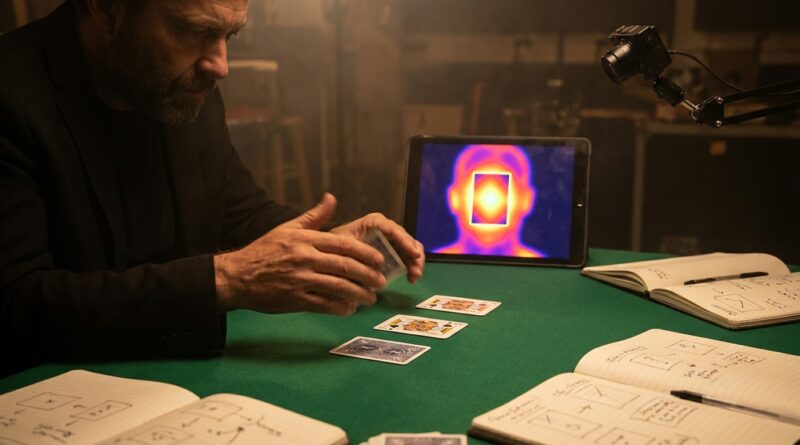
From Patter To Pure Deception: How New Research On Misdirection Can Turbo‑Charge Your Sleight Of Hand
You can spend all week polishing your patter and still get caught. That is the annoying part. A lot of magicians were taught that the right line at the right moment will pull eyes off the dirty work. Then they film a set, watch it back, and see the truth. The audience was looking straight at the hands the whole time. Fresh research around a three card monte study points to something many workers have felt for years. Words matter less than we thought. What really shifts attention is timing, body position, framing, and when the action seems to be over. That is good news, because it means better misdirection is not about becoming funnier or more talkative. It is about building moves that survive direct gaze. If you care about patter misdirection sleight of hand three card monte study results, the lesson is simple. Stop asking how to make them look away. Start asking how to fool them while they look right at it.
⚡ In a Hurry? Key Takeaways
- Recent findings suggest spoken patter is often weaker than timing and body cues for directing attention during sleight of hand.
- Practice key moves under direct eye contact and camera heat, not only under “look over there” moments.
- This matters for real gigs because audiences are more observant, more filmed, and more familiar with magic methods than ever.
What the new research is really saying
The big idea is not that patter is useless. It is that patter gets too much credit.
In studies built around three card monte style deception, researchers looked at how people track action, where attention goes, and what actually makes a false belief stick. The surprising bit is that spectators often keep watching the action area even when the performer is talking. They are not as easily “sent away” by words as magicians like to believe.
That sounds bad until you flip it around. If people are watching closely anyway, then the best path is not to depend on verbal distraction. The better path is to make the move look natural, place it in a moment that feels finished, and shape the scene so the important secret action does not read as important.
In plain English, people can stare at the hands and still miss the method if the structure is strong enough.
Why this hits close-up magicians especially hard
Close-up workers live in the danger zone. Spectators are nearby. Phones come out. Replay exists. People know what a false transfer is. They have seen expose videos, slow motion clips, and endless “guess which hand” bits online.
That old idea of “just hit them with a line and do the move” is getting shakier by the year.
The new lesson is more demanding, but also more useful. Build sleight of hand that can stand up under heat. Then use speech as seasoning, not as the whole meal.
Patter still matters, just not in the way many magicians think
Use patter to shape meaning, not to yank eyeballs
Good patter can relax a crowd, set a premise, create rhythm, and make an effect feel impossible. That is valuable. It can also mark what the audience should remember later, which is huge for a routine’s impact.
But if your script exists mainly to cover a weak move, the research should make you pause.
Words are often best at doing these jobs:
- Framing what is supposed to matter.
- Creating a clear before-and-after moment.
- Slowing or speeding audience expectations.
- Giving a reason for your actions.
Those jobs are different from “making them look away.” That distinction matters.
Think less distraction, more conviction
The strongest deception often happens when the audience feels they saw everything clearly. That is the sweet spot. Not confusion. Confidence.
Three card monte is a great example. The game works not because people stop looking, but because they think they tracked the key card fairly. Their certainty is the trap.
How to use this in real practice
1. Rehearse under direct gaze
This is the biggest change most performers should make. Stop saving the move for your “offbeat” in every practice run. Train while imagining someone is burning your hands.
That means:
- Practice the sleight with your eyes up and engaged.
- Film from spectator height, not only from your own point of view.
- Run the move in silence so you know whether it works without verbal cover.
- Test it with a friend who is told exactly when to watch for a move.
If the method falls apart the second someone focuses on the hands, that is not a patter problem. It is a construction problem.
2. Move the secret action to a moment that feels empty
People notice actions that seem important. They miss actions that seem ordinary or already resolved.
So ask yourself:
- Can the sleight happen after the apparent effect is already mentally locked in?
- Can it happen during a natural squaring, turning, or relaxation beat?
- Can the hand path match what that hand would do anyway?
This is where body timing beats chatter. A tiny pause, a breath, a glance up, or a shift in posture can make one beat feel central and another beat feel irrelevant.
3. Clean up your frames
Framing sounds fancy, but it is simple. What sits in the audience’s mental picture? What sits outside it?
If the dirty hand is tense, isolated, and hanging in space, you are putting a spotlight on it. If both hands move in a balanced, motivated way, the audience reads the whole picture instead of zooming in on one suspicious point.
Think like a camera operator. What looks like the main event? What looks like setup or cleanup?
4. Cut lines that do not earn their keep
A lot of magicians use too many words around a move because silence feels scary. But extra talk can create its own problems. It can sound like stalling. It can also accidentally flag the very moment you want to soften.
Try this test. Remove every line said during the secret action. Then add back only what improves clarity, rhythm, or character.
If a line exists only to “misdirect,” it may be weaker than you think.
What this means for three card monte style routines
The patter misdirection sleight of hand three card monte study angle is especially interesting because monte is often sold as a game of eye control. “Watch closely.” “Keep your eye on the queen.” “You’ll never catch me.” That style makes us assume the battle is mostly verbal.
It is not.
The real strength of monte comes from structure. Repetition creates confidence. Rhythm creates prediction. Fair-looking handling creates false memory. The spectator does not lose because they looked away. They lose because the sequence built a convincing lie.
That should change how you script monte and monte-like effects. Your words should support the conditions of fairness, not act like a smoke bomb.
Practical drills you can start tonight
The silent run
Perform the full sequence with zero patter. If the trick becomes much weaker, identify exactly why. Did the audience need clearer effect framing, or were you depending on words to hide bad timing?
The burn test
Ask a friend to stare only at the hand doing the work. Tell them a move will happen. Your goal is not to stop them looking there. Your goal is to make the move unreadable anyway.
The phone test
Record in bright light from close range. Watch in normal speed first. Then slow it down. If the method flashes in normal speed, fix that before you worry about script polish.
The freeze-point test
Pause the video at random moments. Do your hands look relaxed and justified? Or does one frame scream, “Something sneaky happened here”?
Body language is doing more work than you think
Here is the part many performers miss. Spectators read your body long before they process your words. If your shoulders tighten before a palm, if your gaze drops before a switch, if your tempo changes only when the move happens, that is a tell.
Good misdirection often looks less like distraction and more like consistency.
Same pace. Same posture. Same hand paths. Same emotional tone.
When everything feels even, the secret action blends into the stream.
So should you throw out your script?
No. Just give it a different job.
Use your script to make the effect memorable. Use it to build trust, tension, and personality. Use it to tell the audience what kind of impossible thing they are about to witness.
But do not ask it to rescue shaky mechanics.
The strongest modern close-up magic combines both. Clean technique that survives heat, plus clear language that sharpens the experience.
At a Glance: Comparison
| Feature/Aspect | Details | Verdict |
|---|---|---|
| Patter as misdirection | Can help with pacing and memory, but often does not fully pull eyes off the method. | Useful support, not a reliable crutch. |
| Body timing and framing | Natural pauses, justified actions, and clean posture often hide more than extra talking does. | The stronger long-term fix. |
| Practice under heat | Testing sleights under direct gaze and on camera exposes weaknesses fast. | Essential for modern close-up work. |
Conclusion
The comforting myth is that a clever line can save a messy move. The harder truth, and the more useful one, is that people often keep watching exactly where the secret happens. That is why this research matters. It turns fresh science into an edge you can actually use at the table. Practice high-heat sleights under direct gaze. Use body timing, structure, and framing to sell the lie. Let patter support the effect instead of carrying the whole load. Do that, and your magic gets tougher, cleaner, and better suited to cameras, paid gigs, and audiences who know more than they used to. That is a real upgrade for the community right now.