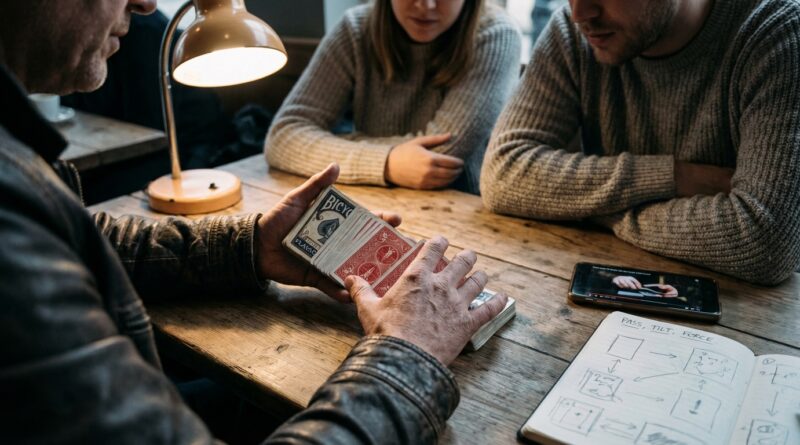
From ‘Self‑Working’ Miracle Clips To Real Workers: How To Turn Algorithm‑Friendly Card Tricks Into Slealth Sleight You Can Actually Use
You have probably felt this already. A “self-working miracle” looks unbeatable on your phone, then turns awkward the second you try it for a real person. The counting feels suspicious. The procedure drags. The spectator has to hold the deck just right, say the right thing, and somehow never ask the obvious question. That is not really self-working. It is camera-friendly. The good news is most of these tricks still hide a strong engine. If you know how to strip out the clunky parts and quietly add one or two simple moves, you can turn a viral fooler into something that feels clean, casual, and strong in the real world. That is the real goal here. Not collecting another puzzle for your feed, but building a trick you can actually carry, perform, and trust when people are burning your hands from two feet away.
⚡ In a Hurry? Key Takeaways
- To learn how to turn self working card tricks into real sleight of hand, keep the effect and replace the suspicious procedure with one hidden control, force, or false display.
- Start by finding the trick’s weak spot. Usually it is the count, the deal, the spelling, or the “free choice” that is not really free.
- The best result is not harder magic. It is simpler-looking magic that survives real spectators, bad angles, and follow-up questions.
Why “self-working” often fails in the real world
There is nothing wrong with self-working card magic. Some of the strongest card tricks ever made use very little finger skill. The problem is the internet version. A lot of viral tricks are built for a viewer who cannot interrupt, cannot touch the deck, and cannot say, “Hang on, do that part again.”
That creates a specific kind of routine. It often has too much procedure and too little freedom. It may rely on a weird dealing pattern, a mathematical stack that collapses if one card shifts, or a force disguised as a choice that only feels fair on video.
When you perform for real people, those weak points show up fast. Spectators talk. They grab. They joke. They forget instructions. If your miracle only works in silence, at one angle, with perfect compliance, it is not ready yet.
The fix: Keep the effect, replace the machinery
Here is the mindset shift that matters. Do not ask, “How do I perform this viral trick exactly as taught?” Ask, “What is the audience supposed to remember?”
Usually the memory is simple:
- A card was lost and found in an impossible way.
- A number was named and a prediction matched it.
- A freely thought-of card appeared in a clean location.
The audience does not care whether that came from spelling, dealing, a key card, a crimp, a force, or a side steal. They care about what it felt like.
That is how to turn self working card tricks into real sleight of hand. Keep the effect. Swap out the ugly plumbing.
Reverse-engineer the trick before you touch the handling
Step 1: Identify the effect in one sentence
If you cannot explain the effect in one sentence, the trick is probably too muddy already.
For example: “They shuffle, think of a card, and I reveal it without touching the deck.” Good. That is clear.
Step 2: Find the method’s weak spots
Most trending “easy miracle” tricks break in one of four places:
- Procedure. Too much counting, spelling, reversing, or sorting.
- Fragility. The setup dies if cards are handled naturally.
- False freedom. The spectator is pushed into a narrow choice.
- Dead time. Nothing magical is happening while the method grinds along.
Circle the exact moment that feels fishy. That is the part to replace.
Step 3: Ask what one sleight would solve it
You usually do not need five moves. You need one useful worker.
If the trick needs a card controlled, use a control. If it needs a known card, use a glimpse or key card. If it needs a fair selection, use a force that matches your style. If the ending needs order, use a false shuffle or false cut to protect it.
The easiest upgrades that make a big difference
1. Replace long counting with a control
Many algorithm-heavy tricks use counting because counting is “easy.” To spectators, though, counting is often the loudest part of the method. It screams, “This part matters.”
Try this instead. Let them select a card, control it quietly, then reveal it through the same ending the self-working trick used. Now the effect is shorter and cleaner, and the audience remembers freedom instead of arithmetic.
A basic overhand shuffle control or double undercut can do this job for years. It is not flashy. That is why it works.
2. Replace restrictive choices with a force
A lot of feed-friendly tricks pretend the spectator had total freedom when they did not. In person, that tension is obvious.
If the routine needs a specific card or packet size, stop pretending and use a real forcing technique that feels natural. A classic force, riffle force, cross-cut force, or slip force can make the same effect feel far more open than a scripted “say stop but not there, a little later” procedure.
The irony is funny. A little real sleight can make a trick look much more hands-off.
3. Replace exposure-prone displays with false ones
Some self-working tricks survive only because the camera hides timing and depth. The cards are not really shown as cleanly as the viewer thinks.
This is where a simple false count, false cut, or convincer earns its keep. If the trick needs to suggest all cards are mixed or all backs are normal, use a display designed for that purpose instead of hoping nobody notices the ugly moment.
4. Replace setup dependence with a deck you can protect
Stacks and cyclical orders are not the enemy. The problem is when a trick needs a perfect setup but gives you no way to preserve it.
Add one false shuffle and one false cut you can do in your sleep. Suddenly a fragile mathematical trick becomes an opener, a middle piece, or a callback later in the set.
A practical example: turning a trending fooler into a worker
Let’s take the shape of a common viral trick. The spectator deals cards into piles, makes a few choices, follows a counting procedure, and somehow lands on their own card or a prediction. On video, it looks impossible. In person, it feels like taxes.
Here is how you rebuild it.
Original internet version
- Spectator picks a card.
- Card is returned under very controlled conditions.
- Several rounds of dealing and counting happen.
- The card appears at a named number or in a chosen pile.
Rebuilt live version
- Spectator picks a card.
- You control it during the return.
- You false shuffle to “lose” it.
- You have them name a number or pile.
- You use the original ending structure, but now you already know where the card is or can place it there.
What changed? The audience experience improved. The method got stronger because it became less visible. Instead of ten steps that look innocent online and guilty in person, you used one hidden action and let the rest feel free.
Build around natural actions, not challenge conditions
This is a big one. Viral trick creators often build around challenge lines such as “I never touched the deck” or “No sleight of hand.” Those lines get clicks. They do not always get gasps.
Real performers know something better. Natural handling beats extreme conditions.
If you casually square the deck, spread it, cut it, and hand it back in a relaxed way, spectators usually accept that as normal. But if you build the whole trick around proving how fair you are, every little action gets more attention.
So when you upgrade a self-working trick, remove the needy claims. Stop proving. Start performing.
How to choose the right sleight for the job
If you are trying to learn how to turn self working card tricks into real sleight of hand, do not start by collecting knuckle-busting moves. Start with utility sleights. The boring ones. The ones workers use every week.
Best first choices
- A control. Overhand shuffle control, double undercut, or side steal if you already have it.
- A force. Riffle force or cross-cut force for reliability. Classic force if your timing is good.
- A false shuffle or cut. Enough to preserve order without looking tense.
- A double lift. Useful if the trick needs a visual switch of identity.
- A glimpse or key card. Great for keeping the self-working feel while quietly adding information.
Notice the pattern. These are not ego moves. They are glue. They let you connect effects, erase weak moments, and make old methods feel modern and loose.
How to practice the upgrade without ruining the trick
Practice the seam, not the whole routine
The dangerous moment is the transition between “self-working procedure” and “hidden skill.” That seam must disappear.
If you are adding a control, practice the return and the next two seconds. If you are adding a force, practice the invitation and the beat after they take the card. If you are protecting a stack, practice the false shuffle until your shoulders stop looking guilty.
Test for spectator memory
After performing, ask yourself what they would report later. If they say, “He made me count a lot,” the method is still showing. If they say, “I picked any card and it ended up exactly there,” you are getting close.
Trim every extra instruction
Most weak tricks get stronger when you cut twenty percent of the words. Maybe more. Every extra instruction gives spectators another place to suspect the method.
What not to do
There are a few easy mistakes here.
- Do not add sleight just to make it “harder.” The point is not to impress magicians with technique. The point is to hide method.
- Do not keep the original procedure if your new move already solved the problem. Once the card is controlled, you may not need all that dealing anymore.
- Do not confuse fairness with complexity. A short, direct sequence usually feels more impossible than a long “clean” one.
- Do not marry the script from the video. A lot of those lines are there to patch weak structure.
Turn one trick into a set piece
The smartest way to use viral material is not as a one-off. It is as raw material. Ask how the trick can fit into a set.
Maybe the “self-working” location effect becomes your opener because you now control the card and can reveal it with almost no procedure. Maybe the mathematical coincidence becomes a callback later because your false shuffle kept the needed order alive. Maybe the impossible number revelation becomes stronger after a previous trick established that the deck was mixed.
That is where real value lives. Not in owning a secret, but in shaping it into something dependable.
At a Glance: Comparison
| Feature/Aspect | Details | Verdict |
|---|---|---|
| Original self-working method | Usually easy to learn, but often heavy on counting, procedure, and perfect conditions | Good source material, not always good performance material |
| Hybrid version with one or two sleights | Uses a control, force, glimpse, or false shuffle to hide the weak spots and shorten the routine | Best balance for most performers |
| Full sleight-heavy rebuild | Can look brilliant, but may add more technique than the effect really needs | Use only if it makes the audience experience cleaner |
Conclusion
The feed is packed with “easy miracle” content because easy sells. But easy to watch is not the same as good to perform. If you want lasting chops, start treating those tricks like blueprints instead of finished products. Reverse-engineer the effect. Find the weak point. Replace it with one quiet, useful move. That is how to turn self working card tricks into real sleight of hand without losing the clean, impossible feeling that made the trick attractive in the first place. Done right, you are not just collecting likes or secrets. You are building practical weapons you can trust in real hands, real rooms, and real sets. That is a much better return than another miracle clip that dies the second someone asks to see the deck again.