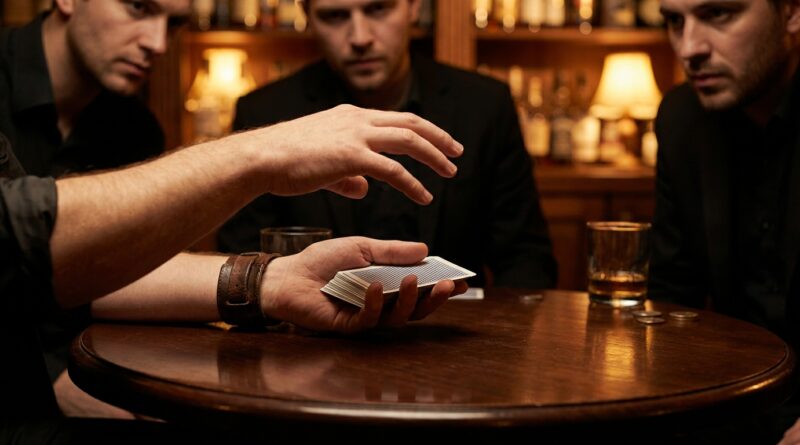
From Two Hands To One Deceptive Moment: Build One ‘Ambidextrous Sleight’ That Works From Any Side Of The Table
You know the feeling. A move looks clean in practice, then the real world shows up. Someone shifts to your weak side. A phone camera dips low. You need to switch hands because of table space, drink placement, or simple bad luck. Suddenly the sleight that felt solid a minute ago starts to feel fragile. That is not just a technique problem. It hits your timing, your eye contact, and your nerve.
The fix is not learning ten new controls or a dozen flashy changes. It is building one deceptive move until it works from either hand, from either side of the table, under normal heat. That is the heart of smart ambidextrous sleight of hand training. Pick one high-value sleight, strip it down, rebuild it for both hands, and test it in real conditions. Once that one move becomes portable, a huge part of your set gets safer overnight. You stop protecting the trick and start performing it.
⚡ In a Hurry? Key Takeaways
- Build one core sleight for both hands first. Do not split your focus across your whole arsenal.
- Practice from four conditions: strong hand, weak hand, left-side spectator view, and right-side spectator view.
- This makes your current material safer in live gigs and on camera, with less backtracking and fewer angle problems.
Why one-sided skill breaks down so fast
Most magicians do not fail because the move is bad. They fail because the move only lives in one setup. One hand. One pocket arrangement. One body turn. One clean viewing lane.
That is fine in a bedroom mirror. It falls apart fast at a table.
Real spectators drift. Friends lean in. A loud room speeds you up. A camera catches the side you never trained. The problem is not that you need more moves. The problem is that your best move is too dependent on perfect conditions.
That is why ambidextrous sleight of hand training matters so much right now. In casual sessions, walk-around work, and short video clips, people are not sitting still and giving you your favorite angle. You need a move that survives motion.
Pick the right sleight to make ambidextrous
Do not start with the move that is most impressive. Start with the one you use most often and can hide inside many effects.
Good candidates
A control. A palm. A false transfer. A top change. A double lift get-ready. A simple switch.
The best choice has three traits.
- You already use it a lot.
- It creates or cancels a moment of heat.
- It can appear in more than one routine.
If you want a useful companion read on this idea, From Smoothest Palms To One-Hand Mastery: Build One Ambidextrous Sleight That Doubles Your Power Overnight gets at the same core problem. Your favorite grip feels great until the wrong person stands in the wrong place.
The goal is not mirror-perfect hands
This part matters. Your left hand does not need to look exactly like your right hand. It needs to create the same deceptive moment.
That is a big difference.
Non-magicians do not score your hand symmetry. They read overall confidence, rhythm, and whether anything looked odd in context. Your weak hand can use slightly different finger pressure or timing if the result feels natural and flies past attention.
Think outcome first, mechanics second.
The four-lane practice method
This is the simplest way to build a sleight that works from any side of the table.
Lane 1: Strong hand, safe angle
Start where you already win. This is your baseline. Film ten clean repetitions. Watch them back. Note what really sells the move. Usually it is not the finger action. It is the pause before, the eye line, and how little your shoulders change.
Lane 2: Weak hand, safe angle
Now switch hands and copy the effect, not every tiny muscle pattern. Go slower than feels necessary. Your weak hand will want to rush because it feels exposed.
Do sets of five. Stop when the move starts looking tense. Reset. Short clean reps beat long sloppy ones.
Lane 3: Strong hand, bad-side spectator view
Turn the camera or chair to the side you usually fear. This is where the truth shows up. A move can feel invisible head-on and flash badly from the side.
Do not panic if it looks rough. That is the point. You are finding the exact frame where the method leaks.
Lane 4: Weak hand, bad-side spectator view
This is the hard lane, and it is where the upgrade happens. If you can make the move survive here, the rest starts getting easy by comparison.
Work in very small chunks. Just the load. Just the steal. Just the replacement. Then stitch them back together.
Build a deceptive moment, not a finger stunt
A sleight becomes strong when the secret action lands inside a believable beat.
Maybe you ask a question. Maybe you slide a glass. Maybe you square the packet because any normal person would. That is the deceptive moment. It should make sense even if there were no trick happening.
When you train ambidextrously, this matters even more. Your hands may feel different, but the outer beat can stay the same. That sameness is what gives the audience a stable picture.
Try this test. Describe out loud why your hands are doing what they are doing. If the reason sounds thin, the move will probably feel suspicious from at least one angle.
Use the 70 percent rule
Do not wait for your weak hand to feel perfect before using it.
If it is about 70 percent as good as your strong hand in low-pressure moments, start feeding it real performance reps. Use it with friendly spectators. Use it in the middle phase of a routine, not the climax. Use it when the effect has built-in cover from attention.
That is how the move matures.
Too many magicians trap their weak-side work in practice forever. Then they wonder why it never catches up. It needs live oxygen.
How to practice angles without driving yourself crazy
Use two cameras if possible
One front view. One side view. Your hands often lie to you while you are doing the move. Video does not.
Mark your danger zones
Do not just say, “It flashes sometimes.” Be specific. Maybe the right thumb opens too much from low right. Maybe the left fingers curl unnaturally when seated. Specific notes create specific fixes.
Change your table distance
A lot of sleights look good when the table sits in the perfect spot. Move it closer. Move it farther away. Stand up. Sit down. If the sleight only works in one body position, it is still fragile.
What usually goes wrong when switching hands
- Your shoulders tense and announce the move before the fingers do.
- Your weak hand over-grips because it does not trust itself.
- Your eyes drop to the action at the exact wrong time.
- Your timing changes, which makes the rhythm feel odd.
- You keep the same script, even though the new hand position needs a different offbeat.
Notice how few of those are purely technical. Most are performance leaks. That is good news. It means the fix is not always months of knuckle work. Sometimes it is a better beat, a better body turn, or a cleaner reason for the hand to move.
A simple weekly plan for ambidextrous sleight of hand training
Day 1: Baseline filming
Ten reps strong hand. Ten reps weak hand. Watch both.
Day 2: Mechanics only
No script. No patter. Just clean handling in short sets.
Day 3: Add the cover beat
Attach a question, gesture, or natural action that hides the method.
Day 4: Side-angle testing
Film from the angle you hate most. Fix one leak only.
Day 5: Real-speed run-throughs
Do the sleight inside the full routine, not in isolation.
Day 6: Live low-stakes use
Try it for a friend, partner, or casual spectator.
Day 7: Review and trim
Keep what looks natural. Cut what feels forced.
This kind of structure keeps you from just “putting in hours” without solving the real problem.
Why this helps more than learning another move
A new move is exciting. It feels like progress. But in working conditions, versatility beats novelty.
One sleight you can trust with either hand and from either side of the table is worth more than three clever moves that need perfect staging. It opens more effects. It saves more recoveries. It gives you more calm.
And calm reads as magic.
At a Glance: Comparison
| Feature/Aspect | Details | Verdict |
|---|---|---|
| Single-hand mastery | Looks great in controlled settings, but often depends on one angle and one body position. | Good foundation, but limited in live conditions. |
| Ambidextrous sleight training | Builds the same deceptive effect in both hands and under side-angle pressure. | Best long-term upgrade for real-world flexibility. |
| Chasing new moves | Adds variety, but often creates a collection of methods you cannot fully trust under heat. | Fun, but lower value than making one core sleight bulletproof. |
Conclusion
The community loves new moves, but what actually stands out in real sessions and online clips is control from any direction. Spectators roam. Cameras drift. Tables get crowded. If you take one high-value sleight and make it work with either hand, from either side, your existing material gets stronger fast. It becomes safer, more flexible, and much harder for people to backtrack. That helps in noisy bars, walk-around gigs, and tight social media frames alike. So do not treat ambidextrous sleight of hand training like a side quest. It is one of the most practical upgrades you can make to everything you already perform.