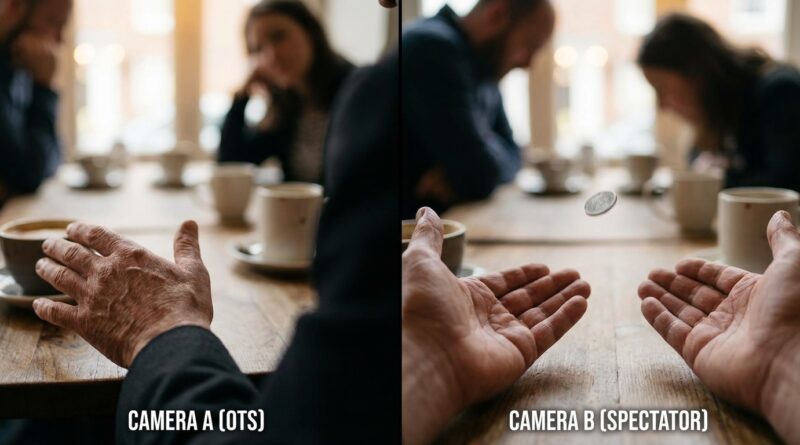
From Viral Multi‑Angle Coin Clips to Real Workers: How To Build ‘Two‑Perspective’ Vanishes That Fool Cameras And Live Spectators
You have probably felt this already. You see a coin vanish on Instagram from the front. It looks impossible. Then the clip cuts to a second angle and somehow it still looks clean. So you try to copy it, only to find the whole thing falls apart the second a real person stands a little left, a little right, or slightly higher than the camera. That frustration is real. A lot of these viral pieces are not fake, but they are built for lenses first and people second. The good news is that the gap is fixable. If you can spot what the camera is being allowed to see, what it is being denied, and how timing is doing half the work, you can rebuild the idea into a multi angle coin vanish sleight of hand that survives in the real world. The goal is not to copy the clip. The goal is to steal the logic and turn it into a worker.
⚡ In a Hurry? Key Takeaways
- A strong multi angle coin vanish sleight of hand is usually built on sightline control, body position, and delayed conviction, not just fast fingers.
- Start by reverse-engineering viral clips into three parts: what is shown, what is hidden, and what motion sells the moment.
- If a vanish only works for two camera positions but fails when a person shifts six inches, treat it as a social media proof of concept, not a finished routine.
Why these vanishes look better online than they feel in person
Most viral coin clips are using a simple truth. Cameras are picky. Human beings are messy.
A camera has a fixed frame. A spectator does not. A camera stays at one height until the editor changes it. A spectator leans in, glances down, steps to the side, and decides when to burn your hands.
That means many flashy vanishes are not really “angle proof.” They are “angle selected.” There is a big difference.
Once you accept that, the clips become much more useful. Instead of asking, “How do I copy this exactly?” ask, “What conditions made this look impossible?”
The three hidden helpers in viral coin clips
Most of them use some mix of these:
Framing. The edge of the frame acts like an extra wall. It quietly removes danger zones.
Sightlines. The hand position is chosen so the dirty action sits behind fingers, knuckles, or the coin itself from the chosen views.
Micro-choreography. A tiny turn of the wrist, a finger curl, a shoulder shift, or a beat of eye contact covers the actual method.
If you want a live worker, you need to keep the effect and replace the fragile conditions.
Start by dissecting the clip, not worshipping it
This is where many magicians lose the plot. They see a smooth clip and assume the move itself is the miracle. Usually it is not. The miracle is the structure.
Watch the vanish at half speed and write down three things:
- When is the audience convinced the coin is still there?
- At what exact instant does the secret action likely happen?
- What movement makes that secret action feel motivated?
That gives you a skeleton. Now you can build a practical version.
This is the same habit that matters when translating flashy visual magic into workable performance pieces. If you liked that idea, From Digital ‘Glitch’ Illusions To Real-World Workers: How To Turn Visual Edits Into Live Sleight Of Hand is worth your time because it tackles the same problem from another angle.
The real secret: build for zones, not angles
“Angle proof” is often a fantasy. “Angle managed” is real.
Think in zones instead:
- Safe zone: spectators can stand here and see everything you want them to see.
- Caution zone: the move still works, but timing and hand height matter more.
- Dead zone: they will catch the transfer, retention discrepancy, finger clip, or concealment.
Your job is not to erase the dead zone. Your job is to shrink it, move it to a place nobody naturally stands, and give your body a reason to keep people out of it.
A simple live test
Stand in front of a mirror or record with two phones at different heights. Better yet, use a friend.
Mark a semicircle on the floor with tape.
Now perform the vanish while the observer checks every 15 degrees. Front. Front-left. Left. Slightly low. Slightly high.
Do not ask, “Did you like it?” Ask, “Where did it stop looking impossible?”
That answer is gold.
How to turn a two-camera vanish into a worker
Here is a practical method.
1. Keep the visual moment
The strongest part of the clip is often one image. The coin seems to sit at the fingertips, then it is gone. Keep that picture. It is the hook.
2. Change the concealment
The original method may use a concealment that only survives one lens height. Replace it with a more forgiving hold. Finger palm, classic palm, JW-style edge positions, nowhere palm, or a relaxed curl may not look as naked on camera, but they often survive better in life.
3. Add a beat of off-time
A lot of social media vanishes are “now-now” moves. The coin is shown and gone in one breath. Live, that can feel suspicious. Add a small in-between action. A look up. A soft rub. A gesture. A transfer of attention.
This lets the method happen before the vanish registers.
4. Rotate the conviction, not the dirt
One of the smartest fixes is to show the hand more openly before the secret action, then slightly close the angle at the moment of concealment, then open again after the effect. Spectators remember the openness. They do not map the exact path frame by frame the way magicians do.
5. Give the body a job
Your shoulders, head, and stance matter. A tiny torso turn can move the weak angle away from the crowd without looking defensive. This is huge. The hands should not have to do all the work.
The best “two-perspective” vanishes use layered deception
If a vanish fools both a front view and a side view, it usually is not because one move is perfect. It is because several smaller ideas overlap.
For example:
- The fingers suggest the coin is still there.
- The wrist position hides the actual retention discrepancy.
- The eyes leave the hand at the right moment.
- The reveal happens from an empty shape that looks honest.
That stack is what you should practice. Not just “the move.”
What live spectators actually read
Real audiences do not inspect your technique the way your phone camera does. They read confidence, rhythm, and whether your handling looks like a normal action or a guilty one.
A vanish with 90 percent technical cleanliness and great timing will beat a technically pure move with stiff, careful body language almost every time.
A training plan that actually builds usable coin work
If you want your multi angle coin vanish sleight of hand to work off-screen, train in layers.
Week 1: Freeze frames
Practice only the display positions and the empty-hand positions. Hold each for three seconds. If those pictures do not look natural, the vanish will never feel clean.
Week 2: Path of motion
Now connect the positions slowly. Watch for finger tension, thumb flashes, and weird wrist locks. Smooth paths beat fast paths.
Week 3: Add angle checks
Use front, left-front, right-front, and slightly low camera positions. Test under normal room lighting, not flattering studio light.
Week 4: Add eyes and script
Say something while doing it. Ask a question. Make eye contact. If the vanish only works when you stare at your own hands in silence, it is not ready.
Week 5: Stress test with real people
Show three casual spectators. One standing, one seated, one who naturally leans in. Keep notes. Where did they look? When did they react? Did anyone ask to see the hand too early?
Common mistakes when copying viral coin handling
Chasing speed
Speed can hide a problem, but it also points a spotlight at it. Smooth is usually better.
Using camera posture in live performance
Some clips are made with chest squared, elbows arranged, and hands floated at a perfect height for the lens. In person, that looks posed. Your posture has to look human.
Ignoring reset and repeatability
A clip can be wonderful once. A worker needs to survive repeats, interruptions, and bad lighting.
Confusing “fooled magicians online” with “strong for laypeople”
Magicians reward novelty. Laypeople reward clarity. Build for clarity first.
How to invent your own two-perspective vanish
You do not need to wait for someone else to release one.
Use this simple formula:
- Choose a convincing display picture.
- Choose a concealment that survives your likely crowd position.
- Add one natural action that justifies the hand movement.
- Test from two strong audience viewpoints.
- Trim any motion that exists only to protect the method.
If the move still looks good when someone stands a little off-center and a little lower than you hoped, you are onto something.
At a Glance: Comparison
| Feature/Aspect | Details | Verdict |
|---|---|---|
| Viral two-angle clip | Looks amazing from selected camera views, often depends on exact framing, timing, and lens height. | Great source of ideas, poor source of direct copying. |
| Live worker vanish | Built for flexible sightlines, natural body position, and repeatable handling under normal conditions. | Less flashy on first watch, much stronger in the real world. |
| Best hybrid approach | Keeps the visual hook of the clip, but rebuilds concealment, timing, and body choreography for spectators. | This is the sweet spot for modern coin magic. |
Conclusion
The smart move is not to sneer at viral coin clips, and it is not to copy them blindly either. They are useful if you treat them like sketches. Multi‑angle coin clips and “insane level coin handling” are exploding across social feeds today, but almost none of them are being translated into practical, audience‑tested material. Once you break them down into sightlines, framing, and micro‑choreography, you can rebuild those ideas as repeatable sleights that work for actual people. That gives you a real training plan, a structure for inventing your own multi angle coin vanish sleight of hand, and a better chance of making your coin work feel just as impossible in person as it does on screen. That is the prize. Not a cool clip. A vanish you can trust.