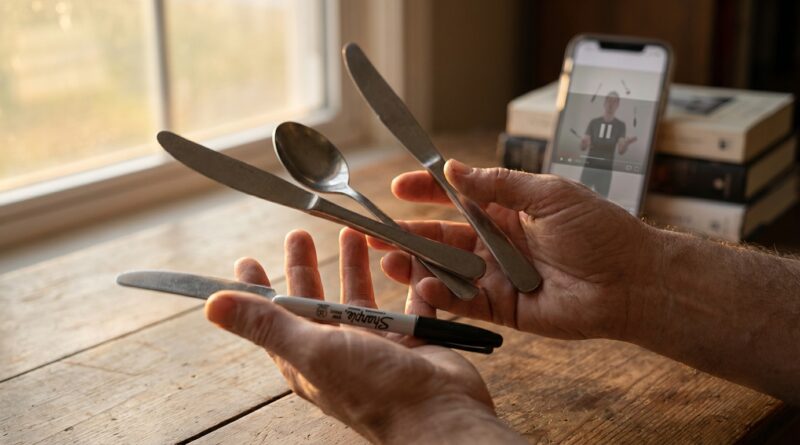
From Viral Knife Juggling Clips to Safe Close‑Up Miracles: How To Steal Everyday Kitchen Moves For Sleight‑of‑Hand Practice
You have probably had this exact thought while scrolling. “That knife flip looked incredible. That cube roll looked impossible. But how on earth do I practice that without slicing a fingertip or spending three hours filming takes?” That frustration is real. Viral clips are built to hide the work. They show the flash, not the drills. They show the clean catch, not the 200 drops that came before it. The good news is you do not need a sharp blade, a camera crew, or circus-level nerve to build that same kind of visual control. You can take the movement ideas from those clips and turn them into safe sleight of hand practice with everyday objects. Think butter knives, spoons, napkins, bottle caps, sugar packets, rings, and sponges. The goal is not to copy dangerous stunts. It is to borrow the feel of them, then train the grips, transfers, tosses, and catches that make close-up magic look impossible.
⚡ In a Hurry? Key Takeaways
- Yes, you can copy the visual style of viral manipulation clips without using dangerous props by training with dull, soft, or low-risk kitchen items.
- Start with ten-minute drills: grip changes, short tosses over a towel, fingertip rolls, and clean catches using spoons, butter knives, corks, and napkin rings.
- Safety matters more than speed. Build control first, film later, and stop before fatigue turns practice into bad habits.
Why Viral Clips Mess With Your Head
Those clips are exciting because they compress skill into one tiny burst. A knife seems to teleport from grip to grip. A cube spins once and lands perfectly. A ring appears to melt through a finger. It looks casual, almost easy.
It is not easy. It is editing, angle choice, repetition, and very specific movement training.
That is why so many magicians feel stuck. Traditional sleight practice often focuses on palms, loads, steals, and timing. Social media manipulation clips reward a different flavor of skill. Finger isolation. Object confidence. Tight visual lines. Quick texture changes between stillness and motion.
The trick is to reverse-engineer the clip instead of worshipping it. Ask one simple question. What is the actual physical skill hiding inside the flourish?
The Safe Way to Reverse-Engineer a Dangerous Move
When you see a flashy kitchen move online, break it into parts.
1. Identify the object type
Is it long and flat like a knife? Boxy like a cube? Circular like a ring? Flexible like a napkin?
2. Identify the action
Was it a spin, a toss, a pivot, a roll across the fingers, or a catch from an awkward angle?
3. Replace the prop
This is the important part. Never start with the risky version. Swap it for a safe stand-in with similar shape and weight.
- Sharp chef’s knife becomes a butter knife, ruler, or wrapped wooden spatula
- Glass bottle becomes an empty plastic bottle
- Metal cube becomes a sponge cube, wrapped box, or eraser block
- Ceramic mug becomes a plastic cup
4. Shrink the movement
Most injuries happen because people practice the “performance size” of the move too soon. Cut the toss height in half. Cut the speed in half. Keep the same path.
5. Add a landing zone
Practice over a folded towel, bed, couch, or close-up pad on a table. A soft landing reduces tension. That matters because nervous hands grab badly.
Build a Ten-Minute Daily Session
If you want safe sleight of hand practice with everyday objects, consistency beats intensity. Ten focused minutes will do more for you than one reckless hour.
Minutes 1 to 2. Warm up your hands
Open and close your hands slowly. Touch thumb to each fingertip. Roll a coin across your knuckles if that is already comfortable. The point is to wake up dexterity, not prove anything.
Minutes 3 to 5. Grip changes
Take one object. A spoon works great. Move it between these positions without dropping it:
- Fingertip pinch
- Thumb clip
- Finger palm
- Display grip
- Back to neutral
Do it slowly. Keep your shoulders relaxed. You are teaching your hands where the object lives.
Minutes 6 to 8. Micro toss and catch
Use a cork, folded sugar packet, or sponge cube. Toss it just an inch or two. Catch with the same hand. Then switch hands. Then catch in a different grip than where it started.
This is where a lot of visual magic is born. Not in huge flourishes. In tiny, reliable transitions.
Minutes 9 to 10. Turn it into an effect
End each session by asking, “How can I make this look impossible?” Maybe the spoon changes hands invisibly. Maybe the cube appears to stick to the fingers. Maybe the ring vanishes during a toss beat.
That last minute is where skill becomes magic.
Best Everyday Objects for This Kind of Practice
Butter knife or dull spreader
Great for learning line control, pivots, and visual displays. It gives you the long-object feel without the obvious danger of a real blade.
Spoon
Excellent for balance, grip changes, and simple aerials. The bowl gives you weight feedback. If it twists unexpectedly, you will feel it.
Cork
Perfect for toss and catch drills. Light, forgiving, and quiet when dropped.
Napkin ring or large key ring
Useful for spins, displays, and penetration-style visuals. If ring magic catches your eye, you might also enjoy How to Turn Viral Ring‑Through‑Finger Clips into a Real‑World Worker You Can Perform Anywhere, which shows how to move from flashy clip thinking into something you can actually perform.
Sponge cube or wrapped box
Good for cube-style manipulation drills. You can practice catches, fingertip balances, and fake transfers without worrying about denting furniture or bruising your knuckles.
Dish towel
Not just for cleanup. A towel gives you friction practice, cover practice, and a safe surface for drops. It also helps you explore how cloth changes the timing of a steal or reveal.
Three Kitchen-Inspired Drills That Actually Help Your Magic
The “Knife Clip” Drill Without the Knife
Take a butter knife or ruler. Start in a basic display grip. Pivot it into a thumb clip. Rotate back out. Freeze at each checkpoint.
What this builds:
- Object awareness
- Finger independence
- Cleaner visual displays
Why magicians should care: this same control improves wand spins, packet displays, pen manipulations, and one-beat vanish setups.
The “Cube Flip” Drill Without the Pressure
Use a sponge cube, gum pack, or small box wrapped in paper. Toss it from one hand to the other with a quarter turn only. Catch softly. Repeat until the object lands flat in your fingers instead of slapping into your palm.
What this builds:
- Timing
- Catch confidence
- Mid-air orientation sense
Why magicians should care: packet catches, color change covers, and visual productions all get better when your hands know how to receive an object cleanly.
The “Casual Table Pickup” Drill
Place a spoon, ring, or folded napkin on the table. Pick it up in one natural motion, but secretly end in a hidden grip instead of an obvious one. Then set it down again as if nothing happened.
What this builds:
- Naturalness
- Secret grip entry
- Confidence under casual conditions
Why magicians should care: real-world magic lives and dies on pickups, put-downs, and those tiny in-between beats nobody practices enough.
What Not to Copy From Social Media
Some things are simply not worth borrowing.
Do not copy speed first
Speed is usually the last layer. If you rush too early, your muscles learn panic instead of precision.
Do not copy camera cheating
A move that only works from one phone angle may look great online and fall apart in person. If your goal is magic, not just content, test from more than one viewpoint.
Do not copy dangerous props for “authenticity”
You are not less serious because you practiced with a spoon before a knife-shaped object. You are smarter. Control transfers. Injuries do too.
Do not grind through fatigue
The minute your catches get sloppy and your fingers stop listening, stop. Tired practice turns into ugly habits fast.
How to Know a Drill Is Working
You do not need viral results in a week. Look for these signs instead.
- You drop the object less often
- Your hands stay relaxed during catches
- You can pause mid-move without losing control
- You can talk while doing the drill
- The object arrives in the same place each time
That last one is huge. Repeatable landing positions are the bridge between flourish and sleight.
How This Turns Into Real Performance Material
Once your drills feel stable, start attaching them to effects. A spoon display becomes a visual vanish. A ring spin becomes a penetration moment. A cube catch becomes a production from nowhere.
This is also where many magicians make a helpful shift. Stop asking, “How do I copy that clip?” Start asking, “What effect can this motion create for a live human standing two feet away?”
That question will keep your practice honest.
At a Glance: Comparison
| Feature/Aspect | Details | Verdict |
|---|---|---|
| Practice props | Butter knives, spoons, corks, sponge cubes, napkin rings, towels, and sugar packets are safe stand-ins for flashy viral objects. | Best starting point for skill without unnecessary risk. |
| Training method | Short ten-minute sessions focused on grip changes, tiny tosses, catches, and natural pickups build control faster than random stunt copying. | Most practical for real improvement. |
| Performance value | These drills improve visual clarity, confidence, and object handling, which can turn into vanishes, productions, penetrations, and cleaner displays. | High value if you connect drills to actual effects. |
Conclusion
You do not need to chase the most dangerous version of a viral move to get the thing that made it exciting in the first place. What you are really after is control. Timing. Confidence. That “wait, did that just happen?” feeling. Safe sleight of hand practice with everyday objects gives you all of that without the stupid risks. And right now, when social feeds are full of ultra-tight “is that sleight or CGI” clips, a lot of magicians quietly feel behind because they do not know how to train that fingertip precision without getting hurt or burning out. The fix is refreshingly simple. Reverse-engineer the motion, swap in safe props, run ten-minute grip, toss, and catch sessions, and let those drills grow into your own close-up material. Do that for a few weeks and you will not just keep up with the visual trend. You will start creating magic that feels organic, modern, and actually performable with the stuff already sitting on your kitchen table.